Kyrgyzstan: The World’s Most Underrated Home of 7000-Meter Peaks
When discussing the great arenas of high-altitude mountaineering, most climbers instinctively think of the Himalaya or the Karakoram. Yet Central Asia — and Kyrgyzstan in particular — hosts some of the most important and historically significant 7000-meter peaks on the planet, offering a level of logistical support that remains virtually unmatched elsewhere.
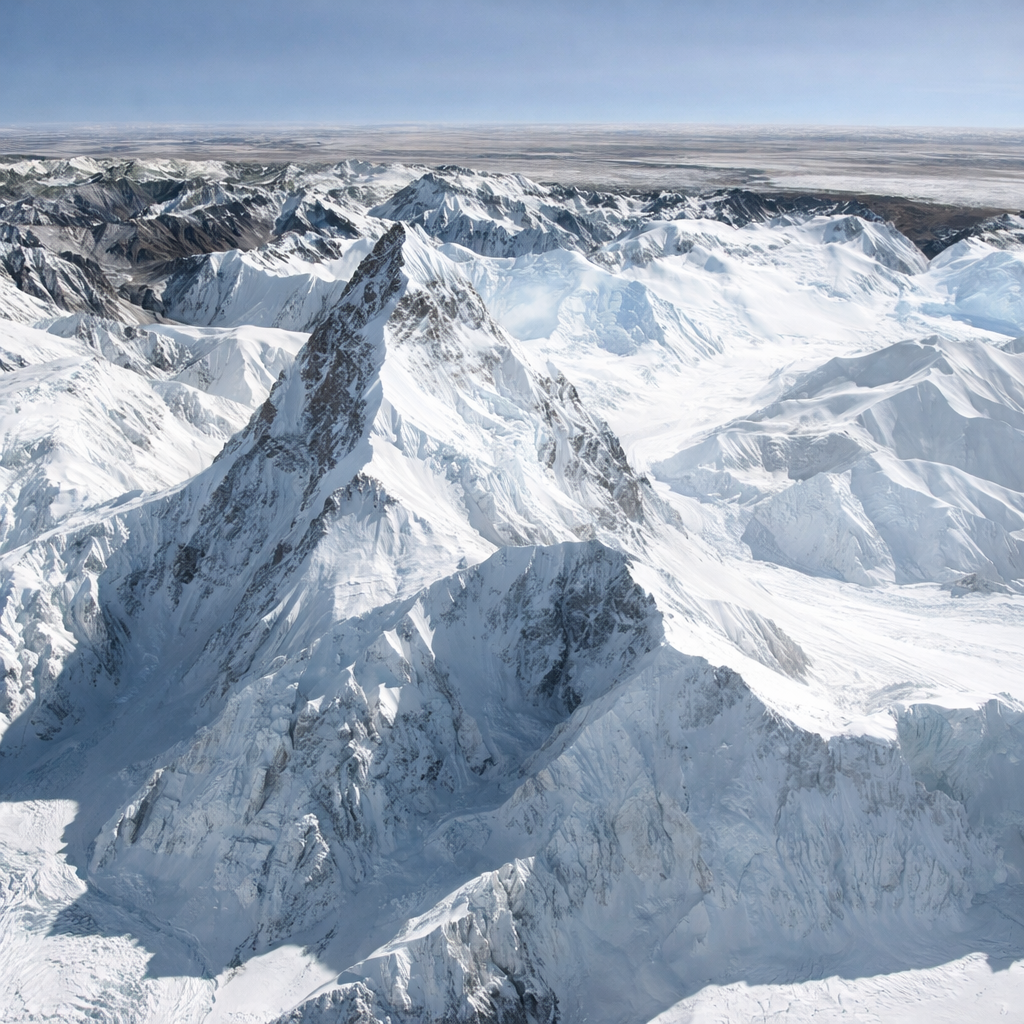
While the Pamir giants Peak Communism (Ismoil Somoni, 7495 m) and Korzhenevskaya Peak (7105 m) are often cited as the crown jewels of the region, Kyrgyzstan’s high-altitude relevance goes far beyond these two legendary summits.
A Concentration of Key 7000ers
Within Kyrgyzstan and its immediate high-mountain sphere lie several of the world’s most climbed and strategically important seven-thousanders, including Lenin Peak (7134 m) — today one of the most frequented 7000 m peaks globally.
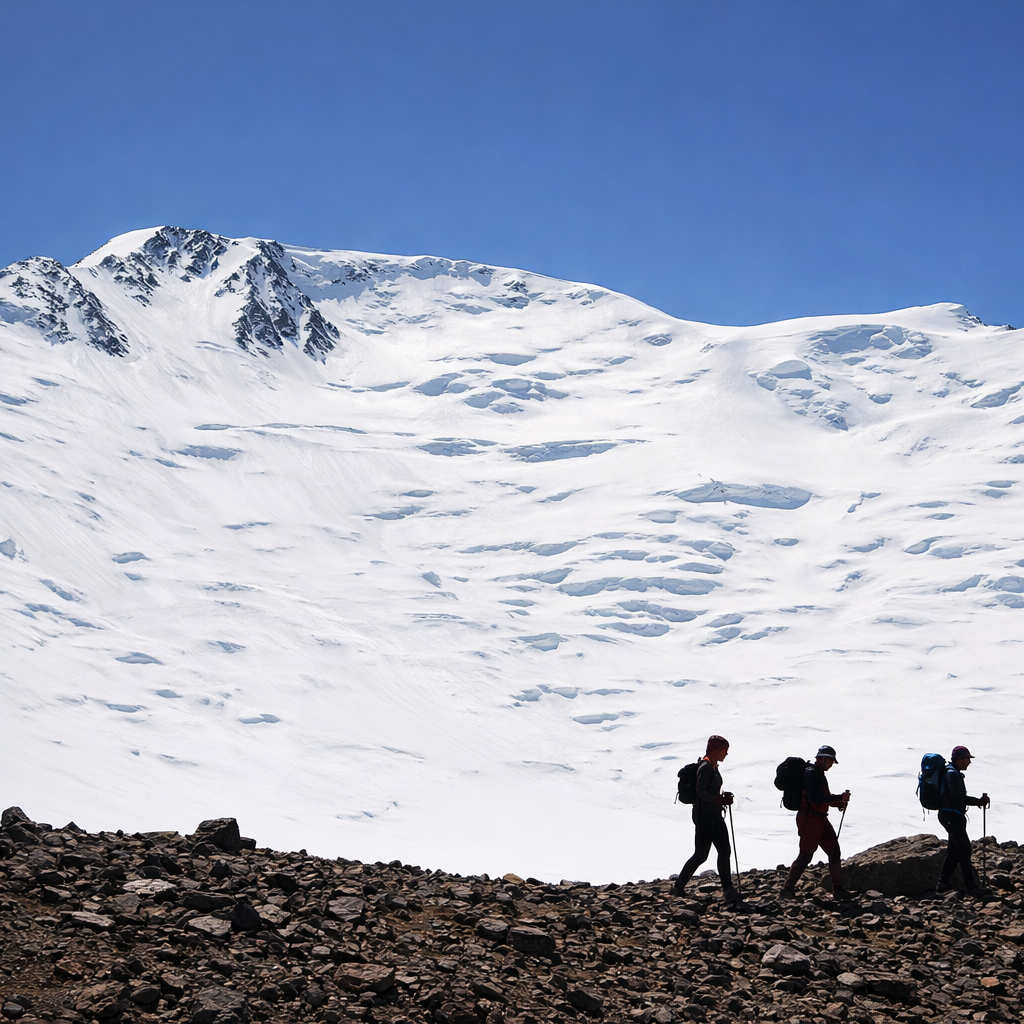
These mountains occupy a unique position in the progression of modern alpinism. For decades, they have served as a natural bridge between technical 6000-meter peaks and Himalayan 8000ers, allowing climbers to gain real expedition experience at extreme altitude without the overwhelming complexity or cost of Nepalese or Chinese expeditions.
Still More Affordable — but Rapidly Changing
For many years, climbing in Kyrgyzstan has been significantly more affordable than comparable expeditions in Nepal or Western China, such as Muztagh Ata or Kongur Shan. Lower permit fees, simpler access, and a long-standing Soviet-era mountaineering infrastructure kept costs comparatively moderate.
However, this gap is narrowing.
-
Prices for logistics, permits, and high-altitude services are steadily increasing
-
Demand from international climbers continues to grow
-
Service standards are rising to meet expectations shaped by Himalayan expeditions
Despite this upward trend, Kyrgyzstan remains one of the last regions where a fully supported 7000-meter expedition can still be organized at a fraction of the cost of major Himalayan peaks.
Himalayan Expertise Comes to Central Asia
One of the most notable developments of the past decade is the arrival of Nepalese Sherpas in the Pamirs and Tien Shan. Increasingly, Sherpas are working in Kyrgyzstan as:
-
High-altitude guides
-
Summit support climbers
-
High-altitude porters
Their presence reflects a broader global convergence of expedition standards. Techniques, risk management practices, and operational models refined on Everest, Cho Oyu, and Manaslu are now being applied on Pamir 7000ers.
This has fundamentally changed what is possible on these mountains.
Oxygen-Supported Ascents Are a Reality
While traditionally climbed without supplemental oxygen, oxygen-supported ascents are now available on several Kyrgyz 7000-meter peaks. This option opens the door to:
-
Older climbers with extensive experience but reduced altitude tolerance
-
Climbers transitioning toward 8000 m peaks
-
Teams prioritizing safety margins over strict alpine ethics
The availability of oxygen does not diminish the seriousness of these mountains — it simply reflects modern expedition realities and individualized risk management.
Established High-Altitude Camps: A Global Rarity
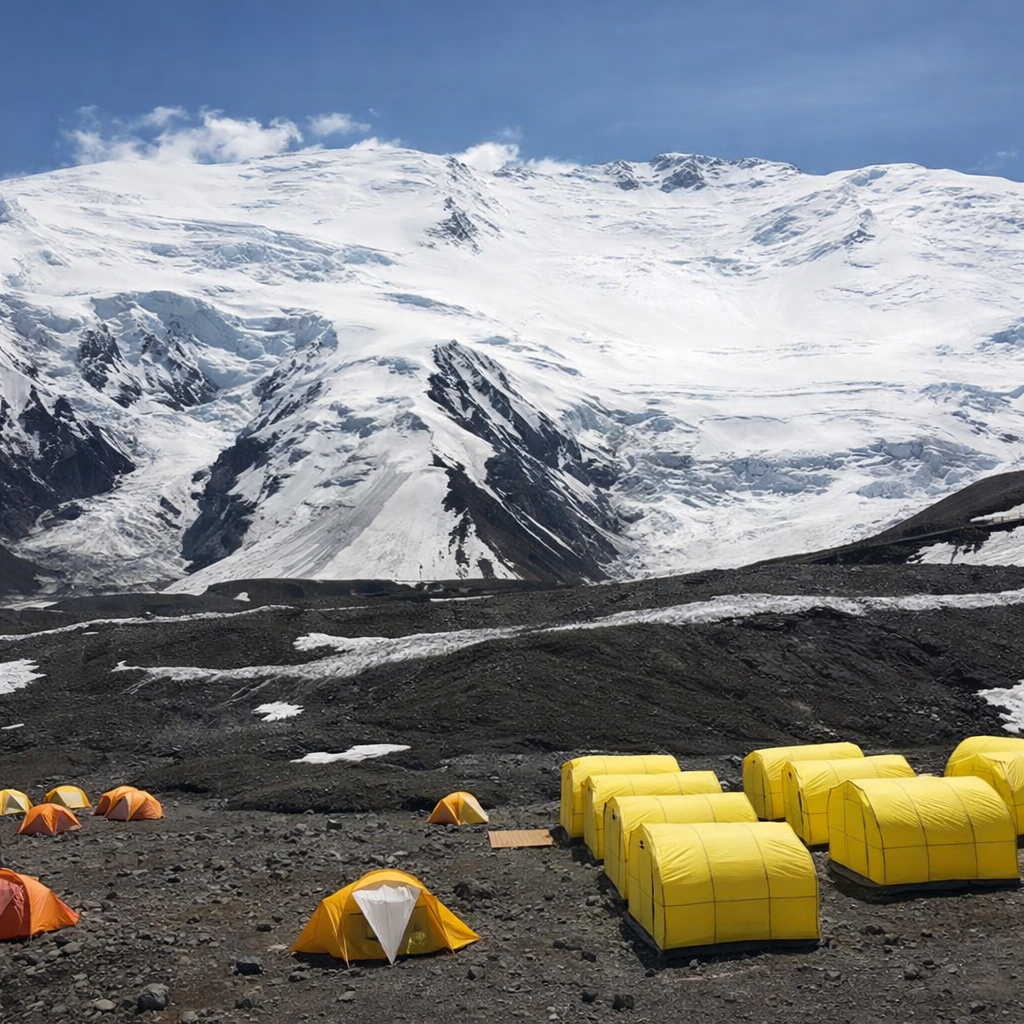
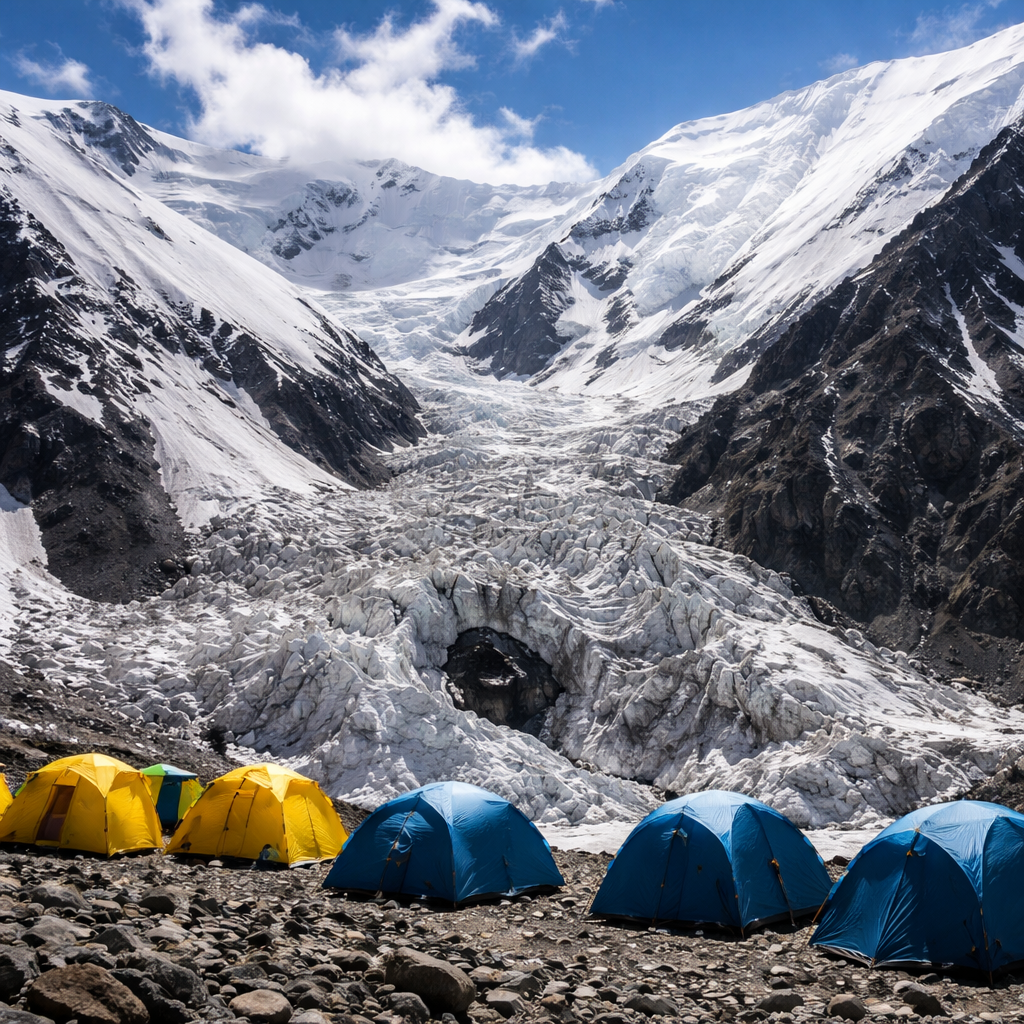
Perhaps the most remarkable feature of Kyrgyzstan’s high-altitude climbing scene is the system of pre-established high camps.
On peaks such as Lenin Peak, climbers benefit from:
-
Permanently installed tents at high camps
-
Platforms, insulation, and wind protection
-
Gas, fuel, and food pre-transported by professional high-altitude porters
-
Medical support and communication systems at altitude
This level of service is exceptionally rare on 7000-meter peaks worldwide. Outside Kyrgyzstan, similar infrastructure is typically found only on a handful of commercial 8000ers — and almost never on mountains of this height.
For climbers, this means:
-
Reduced load carrying during acclimatization
-
More controlled summit pushes
-
Greater focus on climbing and decision-making rather than logistics
A Unique Place in Modern Alpinism
Kyrgyzstan today occupies a unique niche in global mountaineering:
-
Higher and more serious than typical trekking peaks
-
Logistically simpler than most Himalayan expeditions
-
Technically accessible but physiologically demanding
-
Supported, yet still undeniably expeditionary
As costs rise and standards continue to evolve, the Pamirs may soon lose their reputation as a “budget alternative.” What they are becoming instead is a fully mature high-altitude arena — where experience, safety, and efficiency increasingly rival the world’s most famous ranges.
For climbers seeking authentic 7000-meter experience with an unprecedented level of support, Kyrgyzstan remains one of the most compelling destinations on Earth — but the window of opportunity is slowly narrowing.
(more…)