
Adrenaline on the Ugam: Why This Is the Rafting Trip You Can Actually Do in Uzbekistan
Forget the paperwork. Forget the border zones. There is one river in Uzbekistan flowing with perfect, crystal-clear adrenaline right now—and it’s less than two hours from Tashkent.
If you are a rafter, you have probably heard the legends. The Chatkal. The Pskem. The Oyga’ing. Names that echo through the whitewater community as mythical, world-class runs. For decades, these rivers were the holy grail of Central Asian rafting, drawing the strongest paddlers on the planet to their Class V and VI rapids.
But here is the truth about those legends right now: they are on hold.
Due to current border restrictions and complex permitting in the region, running the “River of Five Canyons” or the infamous Oyga’ing-Pskem section is simply not possible.
And you know what? That is perfectly fine.
Because while the legends sleep, the Ugam River is wide awake, running high, and waiting for you. And honestly? It might just be the most fun you’ll have in Uzbekistan.
The Ugam: Not a “Consolation Prize,” But a Genuine Thrill
Don’t make the mistake of thinking the Ugam is the “easy” option. It is the smart option. It is the river that gives you everything you came for—rapids, scenery, and adventure—without the logistical nightmare.
Imagine this: You wake up in Tashkent, grab your gear, and within two hours you are strapped into a raft, staring down an 11-kilometer stretch of living, breathing mountain water.
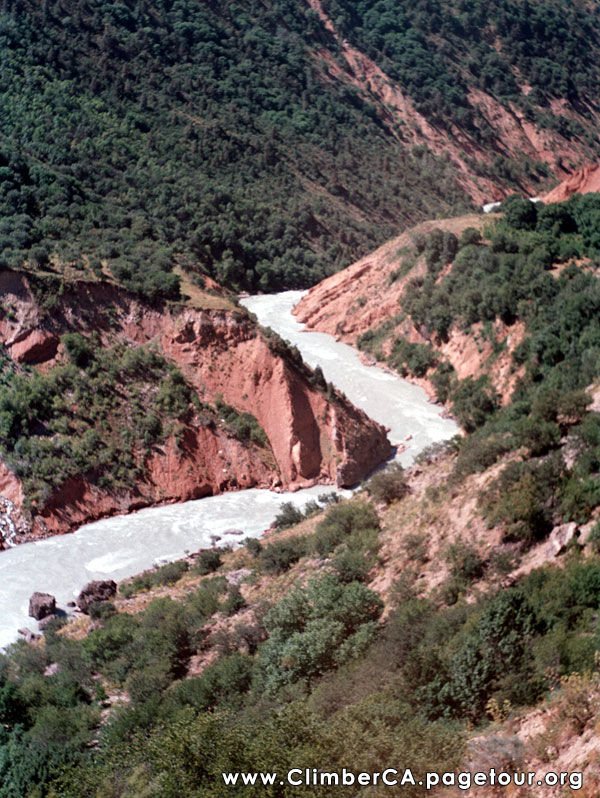
The Ugam flows from the village of Humsan down to the turquoise waters of the Khodjikent reservoir. In the spring, when the snowmelt comes crashing down from the Western Tien-Shan mountains, this river comes alive.
Here is what is waiting for you on the water:
-
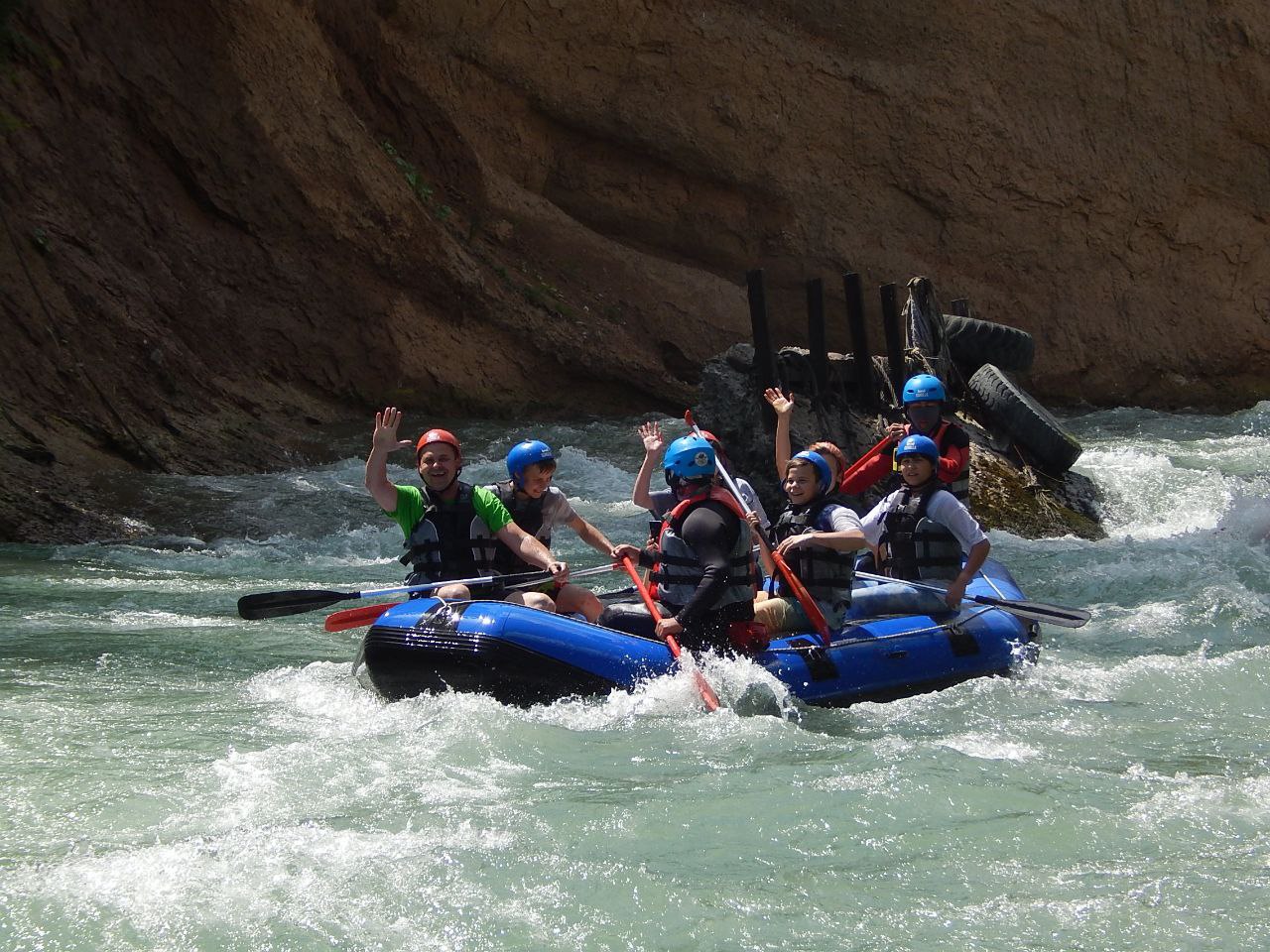
Technical play: This isn’t a straight shot. You’ll navigate around above-water rocks, dodge submerged surprises, and feel the current pin you against granite walls.
-
Active maneuvering: In some spots, you’ll need to slide through sideways. In others, it’s a full-team effort to punch through the rapids.
-
Instant accessibility: The beauty of the Ugam is that it’s remote enough to feel wild, but safe enough that you can pull over for an emergency landing at almost any point.
It is the perfect balance of thrill and security. You get the adrenaline rush of real whitewater, but you don’t get the anxiety of being trapped in a remote canyon with no exit.
Two Ways to Ride: Choose Your Adventure
One of the best things about the Ugam is that it changes with the seasons—and that means we can offer two completely different experiences depending on when you visit.
Option A: The Spring High-Water Run (April – Mid June)
This is the prime time. The river is fat with snowmelt, the current is fast, and the rapids are punchy. This run is for the purist. You’ll make a double trip down the 11-kilometer stretch because one run simply isn’t enough. It’s active, it’s wet, and it leaves you grinning. If you came to Uzbekistan looking for rapids, this is your window.
Option B: The Sunny Summer Float (Late June – July)
As the water drops, the Ugam mellows out. The rapids soften, and the river transforms into a scenic, playful float. This is the perfect trip for:
-
Families with kids who want a taste of adventure.
-
Large groups of friends who want to enjoy the mountains together.
-
Anyone who wants to be on the water, soak in the sun, and cool off in the crystal-clear river without the intensity of high-water rafting.
It is still active. It is still beautiful. It is just… chill.
Why This Trip Works (For Real Rafters and First-Timers Alike)
Let’s be honest: organizing a trip in a foreign country can be a headache. Permits, transport, language barriers—it adds up.
This trip removes all of that.
-
It’s a one-day commitment: You don’t need to pack for a week in the wilderness. You just need a day.
-
It’s accessible: The put-in and take-out are easy. The take-out is actually at the Khodjikent reservoir, a beautiful spot to relax after your run.
-
Expert guides: Our team knows the Ugam intimately. Every rock, every eddy, every rapid. You are in safe hands.
-
Proven safety: In the unlikely event of a swim, the river allows for quick and easy landing options throughout the entire route.
The Bottom Line
The legends of Uzbek rafting—the Chatkal, the Pskem, the Oyga’ing—are not gone forever. They are waiting. And when they open up, we will be the first to take you there.
But right now, the Ugam River is flowing. It is beautiful. It is fun. And it is ready for you.
Don’t spend your trip dreaming about rivers you can’t run. Come get wet on the one you can.
Book your seat on the Ugam today.
Booking & price
Short references +99898 3039846
https://t.me/ClimberCA – telegram
WhatsApp / Viber +7966 065-53-44
e-mail – your@climberca.com
The Legendary Whitewater of Uzbekistan: A Look Back at the Rivers That Defined an Era

For decades, the mountain rivers of Uzbekistan held a secret whispered among the world’s elite paddlers. With sections rated up to Class VI, the highest level of difficulty, these weren’t rivers for the faint of heart. They were a proving ground. Fed by the snows of the Western Tien-Shan, the Chatkal, Pskem, and Oyga’ing once offered multi-day expeditions through pristine canyons, challenging even the strongest international sportsmen. While these legendary routes are currently inaccessible due to border sensitivities, their legacy continues to inspire. This is the story of those rivers—a glimpse into a remarkable whitewater past, and a hope for what may one day be possible again.
The Crown Jewel: The Chatkal River (“The River of Five Canyons”)
The 223-kilometer Chatkal is the heart of Uzbek whitewater lore. For those fortunate enough to have traveled it, the name alone evokes memories of primeval beauty and relentless challenge. Of its total length, 183 kilometers were once run by rafters, descending a staggering 1,267 meters from source to finish.
What made the Chatkal unique was its progressive nature. Paddlers would face no fewer than fifty serious obstacles, building in intensity towards a dramatic climax in the lower reaches. The gauntlet included:
-
Thundering Waterfalls: The First Canyon began the journey with a perilous two-step waterfall dropping roughly four meters, followed immediately by a hundred-meter stretch of steep rapids. Here, the powerful inflow of the Ters River, a major left tributary, cascaded down a rocky ledge—a true spectacle.
-
Technical Rapids: The Hargush rapids were considered the hardest obstacle on the river. For one and a half kilometers, the river unleashed powerful torrents through boulder fields. In one notorious spot, stones nearly blocked the entire river, leaving a gap of only two or three meters, through which the water plunged in a two-meter fall. Running Hargush demanded respect and extra safety measures. Following Hargush in decreasing complexity were the Pigak, Kishlaksay, Second Slalom (Shabrez), and Naizinskiy rapids.
-
Claustrophobic Gorges: The grandeur of the canyons was unforgettable. The Second Canyon’s towering stone walls and slopes were breathtaking. The Third Canyon was a narrow, winding corridor of wet, dark-grey rock, rising 200-300 meters high. The riverbed narrowed to just 6-8 meters in places, with the sky reduced to a thin blue ribbon above, occasionally blocked by dangerously hanging cornices. Somber entrances to grottos and caves dotted the walls.
-
The Final Act: The most dangerous rapids lurked in the Fifth Canyon, including a two-kilometer section where the rocks formed an incredibly narrow corridor. The tightest squeeze was aptly nicknamed “the diaphragm” by tourists. Beyond it, the river gradually calmed, the canyon opened, and the journey mellowed towards the end. The last rapid on the Chatkal was Aurahmat, a seasonal feature that only appeared during irrigation water releases.
The setting itself was as imposing as the whitewater. The river flowed through floodplain forests and alpine meadows, the air thick with the scent of flowers and conifers. The wide intermountain depression was framed by the snowcapped peaks of the Chatkal and Sandala Ridges, dominated by the colossal 4503-meter Chatkal Peak—the highest point of the Western Tien-Shan—and its neighbor, Chatkal Ushba.

Approaches to the upper Chatkal were long but comfortable. The southern route led from the Uzbek city of Namangan through the Chapchama Pass (2841m) in the Chatkal Ridge. The northern route started from the Kazakh city of Taraz, crossing the Karabura Pass (3300m) in the Talass Ridge. The journey’s end was more convenient; the take-out at Ugam-Chatkal National Park was connected to Tashkent by a modern highway, just two hours away.

The Ultimate Test: The Oyga’ing and Pskem
If the Chatkal was a classic, the combined route of the Oyga’ing and Pskem rivers was the stuff of extreme legend. Classified as Class VI, it placed Uzbekistan on the map alongside world-class whitewater destinations like Turkey’s Çoruh River, the Himalayas’ Arun, Africa’s Blue Nile, and the great rivers of the Russian Altai.
The route’s extreme technical difficulty came from a series of brutal obstacles:
-
The Big Inrush on the Oyga’ing: Here, the river thundered through massive, fragmented blockages of five major stone obstructions.
-
The Teparskiy Obstruction on the Pskem: A main waterfall was formed where two converging rocks forced the entire river through a powerful, pinched drop.
-
Rapids with Attitude: The names of the other rapids told the story: Kovarniy (Treacherous), Shtopor (Corkscrew), Gorka (Hill), and Vorota (Gates) .
Despite these fearsome reputations, the rivers also offered options for the less experienced. In the past, rafters were recommended to run lower sections of the Pskem to the Charvak Reservoir, either starting below the Tepar obstruction or from the Pskem settlement (portaging the Teparskiy rapid). These trips ranged from 20 to 40 kilometers, were guided by experts who knew the local conditions perfectly, and fell into the more manageable Class IV category. This allowed adventurers to experience the breathtaking beauty of the Oyga’ing and Pskem valleys—the perfect weather, the stunning rivers and mountains—without taking on the full extreme challenge.
The Other Rivers: Ugam and Ahangaran
The Ugam and Ahangaran rivers offered shorter, more accessible, yet still exciting trips.
-
The Ugam River: This 11-kilometer run from the “Ugam” resort to the Hojikent reservoir was a favorite for a double-run day. Paddlers would contend with a rapid current, dodging above-water rocks and submerged stones, and maneuvering through spots where the stream pushed them against the canyon walls. A key feature was its safety: in an emergency, a prompt landing was possible at almost any point.
-
The Ahangaran River: A longer 30-kilometer journey starting at the mouth of the Yakkaarchasay River and ending before the Angren reservoir. Its main attractions were two standout rapids, Ertash and Koksaray, which provided the core challenges.
A Glimpse of the Past, A Hope for the Future
The best time to experience these legendary rivers was always April and May. The weather was ideal, the snowmelt provided perfect water levels, and the mountain valleys burst into a spectacular bloom of color.
Today, running these world-famous routes is not possible. They flow through sensitive border zones, and the logistical challenges of obtaining permissions have, for the time being, put them out of reach. But the stories endure. The Chatkal, the Pskem, the Oyga’ing—they remain in the memories of those who ran them and in the dreams of those who hope to one day answer their call. They are a testament to a remarkable era of exploration, and a reminder of the incredible whitewater that lies waiting in the heart of Central Asia.