
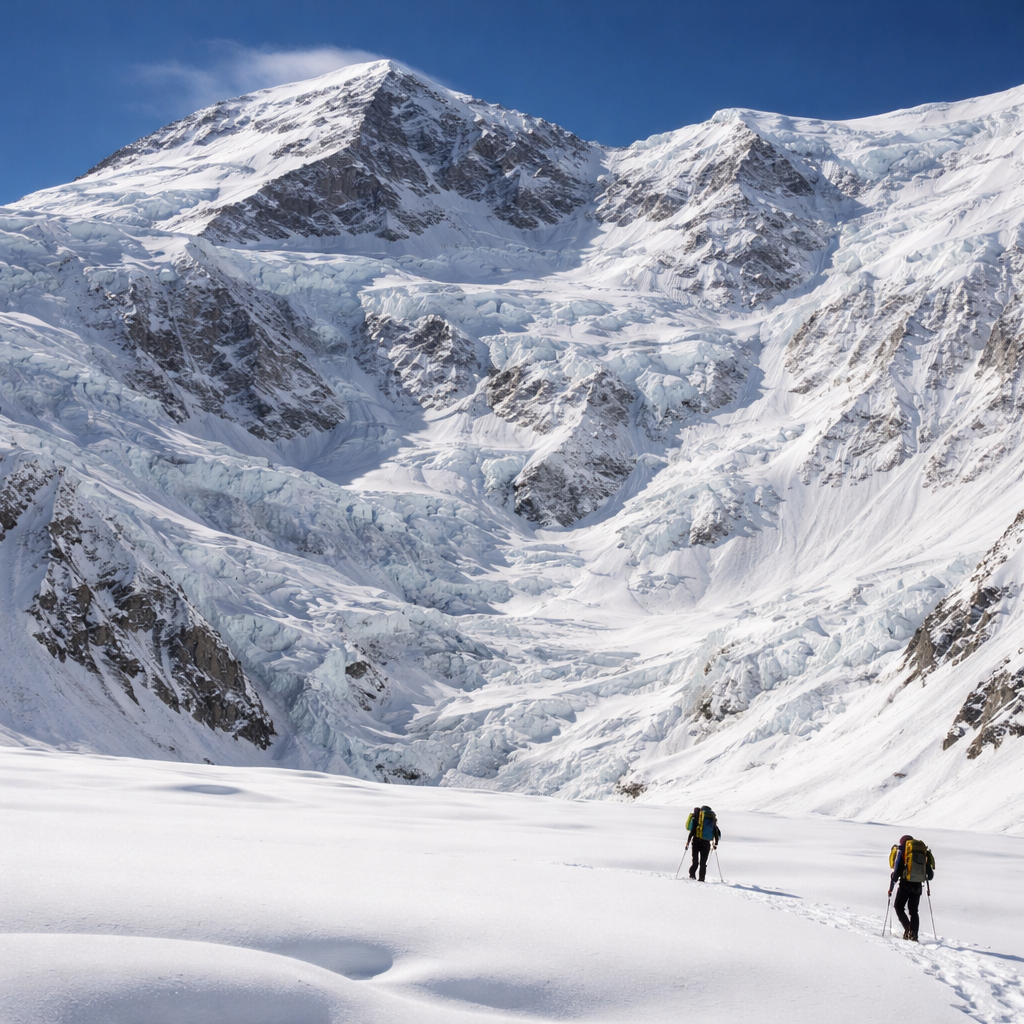
Pobeda Peak (Jengish Chokusu, 7,439 m)
Восхождение на пик Победы (7439 м) — экспедиция 2026 | ClimberCA
High-Altitude Expedition Program, Route Description, Services & Pricing
General Overview
Pobeda Peak (Jengish Chokusu, 7,439 m) is one of the most serious and demanding mountaineering objectives in Central Asia. It is located in the Kokshaal-Too Range of eastern Kyrgyzstan, directly on the border with China, and is recognized as the northernmost 7,000-meter peak of the Tien Shan.
The Pobeda massif consists of several summits along the northern spur — Main Peak, Western Pobeda, and Nuru Peak — with only the Main Peak exceeding 7,000 meters. The mountain is notorious for its extreme weather, long exposed ridges, technical terrain, and high objective danger. Wind speeds can exceed 120–150 km/h, blizzards are frequent, and temperatures often fall below −30°C even during the climbing season.
Pobeda allows no margin for error. Throughout its history, even highly experienced climbers have been lost on its slopes. Route difficulties range from Russian grades 5A to 6A, depending on conditions, making Pobeda one of the most technically and psychologically demanding seven-thousanders. A successful ascent requires excellent physical conditioning, strong high-altitude experience, disciplined acclimatization, and confident rope-team skills.
Organizer & Contacts
Supplier of services: ClimberCA International Consortium
 Email: your@climberca.com
 WhatsApp / Viber: +7 966 065‑53‑44
 Telegram: https://t.me/ClimberCA
ClimberCA delivers top‑quality high‑altitude expedition services at competitive prices. Explore the full range of programs on our website — some offerings are truly unique and unmatched on the market.
Expedition Itinerary
Day 1 — Bishkek
Arrival in Bishkek. Meeting at Manas International Airport, transfer to the hotel, check-in. Evening at leisure: city walk, final equipment check, expedition briefing, and preparation.
Day 2 — Bishkek – Karkyra Yurt Camp
Overland transfer to Karkyra Yurt Camp (approx. 460 km). Accommodation in yurts, meeting with the expedition team, camp orientation, and preparation for the helicopter flight.
Day 3 — Karkyra – South Inylchek Base Camp (4,000 m)
Helicopter flight to South Inylchek Base Camp with panoramic views of the central Tien Shan. Accommodation at Base Camp.
Days 4–5 — Base Camp Acclimatization
Acclimatization walks, medical checks, rope-team organization, equipment preparation, and planning of load carries and climbing rotations.
First Acclimatization Rotation
Day 6 — Base Camp – Camp 1 (4,200 m)
Ascent across the Inylchek Glacier. Rope travel through crevassed terrain. Duration 5–7 hours.
Day 7 — Camp 1 – Camp 2 (5,300 m)
Ascent via Dikiy Pass and a steep icefall. This section is objectively dangerous due to avalanche and serac exposure from the north face of Pobeda. Efficient movement is essential.
Day 8 — Camp 2 – Camp 3 (5,800 m)
Ascent along a broad snow ridge. Camp 3 is usually established in snow caves for better wind protection.
Day 9 — Camp 3 – Camp 4 (6,400 m)
Ascent over steep snow and ice slopes with mixed rock sections (UIAA II–III). Camp 4 is exposed and demanding.
Day 10 — Camp 4 – Camp 1
Long descent to lower altitude for recovery.
Days 11–12 — Camp 1 – Base Camp
Return to Base Camp. Rest, medical monitoring, and preparation for the summit rotation.
Summit Rotation
Day 13 — Base Camp – Camp 1
Re-ascent to Camp 1. Movement is easier due to prior acclimatization.
Day 14 — Camp 1 – Camp 2
Ascent to Camp 2 along the established route.
Day 15 — Camp 2 – Camp 3
Ascent to Camp 3. Final major acclimatization night below 6,000 meters.
Day 16 — Camp 3 – Camp 4
Ascent to Camp 4. Steep snow and ice slopes, often accompanied by strong winds.
Day 17 — Camp 4 – Camp 5 (6,900 m)
Ascent to Camp 5, located on the southern (Chinese) side of the summit ridge. One of the most physically demanding days of the expedition. Camp is usually established in snow caves or high-altitude tents.
Day 18 — Summit Day: Pobeda Peak (7,439 m)
Early alpine start. The route follows a long, exposed snow ridge (approximately 2 km above 7,000 m) to the base of the summit pyramid. The final ascent requires sustained effort at extreme altitude in severe weather conditions. After a short stay on the summit, a careful descent back to Camp 5.
Day 19 — Camp 5 – Camp 3
Long descent following the summit attempt. Strict focus on safety and controlled movement.
Day 20 — Camp 3 – Camp 1
Continued descent through snow and glaciated terrain.
Day 21 — Camp 1 – Base Camp
Return to Base Camp. End of the climbing phase.
Contingency and Return
Days 22–24 — Reserve Days
Weather and safety reserve days. Used in case of delays or additional summit attempts.
Day 25 — Base Camp – Karkyra – Bishkek
Helicopter flight to Karkyra, followed by overland transfer to Bishkek. Hotel accommodation.
Day 26 — Bishkek
Free day for rest, sightseeing, and farewell dinner.
Day 27 — Departure
Transfer to Manas International Airport and departure home.
Route Description (Technical Overview)
-
Base Camp – Camp 1: Relatively straightforward glacier travel; crevasses increase near Camp 1.
-
Camp 1 – Camp 2: Icefall and Dikiy Pass; high avalanche and serac risk.
-
Camp 2 – Camp 3: Broad snow ridge; Camp 3 typically established in snow caves.
-
Camp 3 – Camp 4: Steep snow, ice, and mixed rock terrain (UIAA II–III).
-
Camp 4 – Camp 5: Steep snow and ice slopes; Camp 5 lies on the Chinese side of the ridge.
-
Summit Push: Long exposed ridge above 7,000 m leading to the summit pyramid; altitude and weather are the primary challenges.
Expedition Price
Economy Package — USD 1,900 per person
Includes:
-
Helicopter flight to South Inylchek Base Camp and back (cargo up to 30 kg; excess USD 5/kg)
-
Transfers: Bishkek – Karkyra – Bishkek
-
Medical consultations
-
Environmental camping fee
-
Long-range radio communication
-
Handheld radios during the climb (groups of 3+)
-
Border zone permit
-
Registration in Kyrgyzstan
Basic Package — USD 3,100 per person
Includes:
-
Airport / railway station meet & greet in Bishkek
-
Transfers: airport / railway station – hotel – airport / railway station
-
Transfers: Bishkek – Karkyra – Bishkek
-
Helicopter flight to South Inylchek Base Camp and back (cargo up to 40 kg; excess USD 5/kg)
-
Hotel accommodation in Bishkek (2 nights, breakfast)
-
Road-transfer lunches
-
Accommodation and full board (3 meals/day) at South Inylchek Base Camp
-
Free use of showers, sauna, toilets, and storage facilities at Base Camp
-
First aid and medical support
-
Environmental camping fee
-
Long-range radio communication
-
Handheld radios during the climb (groups of 3+)
-
Border zone permit
-
Registration in Kyrgyzstan (if required)
Not Included
-
Kyrgyz visa (if required)
-
International flights
-
Pobeda Peak climbing permit
-
Route deviations or additional rotations
-
Beverages and food outside the Base Camp menu
-
Personal expenses
-
Mountain guide and high-altitude porter services
-
Personal equipment rental
Optional Additional Services
-
High-altitude tent rental — USD 100 (entire program)
-
Gas cartridges (KOVEA, 230 g) — USD 15 per cartridge
-
International satellite calls — USD 5 per minute
-
Internet access — USD 5 per hour
-
Oxygen cylinder — USD 650 per unit (+ USD 50 refundable deposit)
-
Oxygen mask and regulator rental — USD 300
Required Personal Equipment
Clothing & Gear:
High-altitude double boots, trekking boots, overboots (recommended), down parka, sleeping bag, sleeping pad, 85-L backpack, Gore-Tex shell, insulation layer, thermal underwear, gloves and overmitts, warm hat, balaclava, warm socks, sunglasses, headlamp with spare batteries, sunscreen, thermos, personal eating kit.
Technical Equipment:
Harness, 4 carabiners, 2 ice screws, ascender (jumar), descender, crampons, ice axe, 3 m cord, trekking poles.
Final Remarks
Pobeda Peak is a true expedition-level mountain intended exclusively for experienced alpinists. Prior climbs above 6,500–7,000 meters, solid technical competence, and strong decision-making skills are essential. Proper acclimatization, conservative judgment, and respect for the mountain’s severe weather define the difference between success and failure. A successful ascent of Pobeda remains one of the most serious achievements in high-altitude mountaineering.